
Role Management and Key Ceremony
Cosmian KMS supports two built-in roles, Operator and CryptoOfficer, so that day-to-day cryptographic use (encrypt, sign, decrypt) can be kept separate from key-lifecycle administration (create, activate, destroy, cross-user access). For deployments that want extra assurance around who can become a CryptoOfficer, the role can optionally require a split-key ceremony: instead of one person activating the role alone, the key that grants it is split across several people, and all of them must cooperate to activate it.
Table of Contents
- Role Management and Key Ceremony
The Officer/Operator two roles model
graph TB
    subgraph "Role model"
        CO["🔐 CryptoOfficer<br/>Lifecycle: Create, Import, Certify,<br/>Activate, Revoke, Destroy, ReKey,<br/>Get, Export, Attribute management<br/>+ ownership bypass on all objects<br/>+ all Operator operations (incl. crypto use)"]
        Op["👤 Operator (default)<br/>Crypto use: Encrypt, Decrypt,<br/>Sign, MAC, Hash,<br/>GetAttributes, Locate, Validate"]
    end

    CO -. "superset of" .- Op
| Role | Config key | Allowed KMIP operations | Can access other users' objects? |
|---|---|---|---|
| Operator | (default, no config key) | Encrypt, Decrypt, Sign, SignatureVerify, MAC, Hash, GetAttributes, Locate, Validate | No |
| CryptoOfficer | crypto_officer_users | All Operator operations + Create, Certify, Import, Get, Export, ReKey, DeriveKey, Activate, Revoke, Destroy, Set/Modify/Add/DeleteAttribute, CreateSplitKey, JoinSplitKey, RNGSeed | Yes, ownership bypass |
RNGSeed (additional input to the server DRBG) is restricted to Crypto Officers once roles are configured; RNGRetrieve stays available to every authenticated user.
When crypto_officer_users is configured but a user is not in the list, the server
assigns the Operator role (minimum privilege). Users are never silently promoted.
The CryptoOfficer ownership bypass applies to KMS-managed objects only. Keys stored in an HSM are not covered: access to them stays governed by the HSM's own admin rules, regardless of CryptoOfficer status.
Turning on CryptoOfficer
There are two ways to grant the CryptoOfficer role, chosen per deployment.
Mode 1: Config-only (no ceremony)
[roles]
crypto_officer_users            = ["key-mgr@example.com"]
crypto_officer_require_ceremony = false   # default
key-mgr@example.com is a CryptoOfficer on first connection. Suitable when physical security
controls or organisational policy already enforce the required trust level.
Mode 2: Split-key ceremony required
[roles]
crypto_officer_users = [
    "key-mgr@example.com",
    "co-backup@example.com",
    "co-auditor@example.com",
]
crypto_officer_require_ceremony = true
ceremony_secret = "0123456789abcdef0123456789abcdef0123456789abcdef0123456789abcdef"
CryptoOfficer privileges are inactive at startup. At least 3 users must be listed
in crypto_officer_users when require_ceremony = true (the server rejects fewer).
Each configured CO candidate activates independently by running their own ceremony
(JoinSplitKey with a fresh set of shares). Multiple COs can be simultaneously active
at any time — activating your own ceremony does not revoke any other currently active
CO.
Walkthrough: a 3-person ceremony
The diagram below follows a ceremony with three custodians, Alice, Bob, and Carol, (which is also the minimum the KMS accepts).
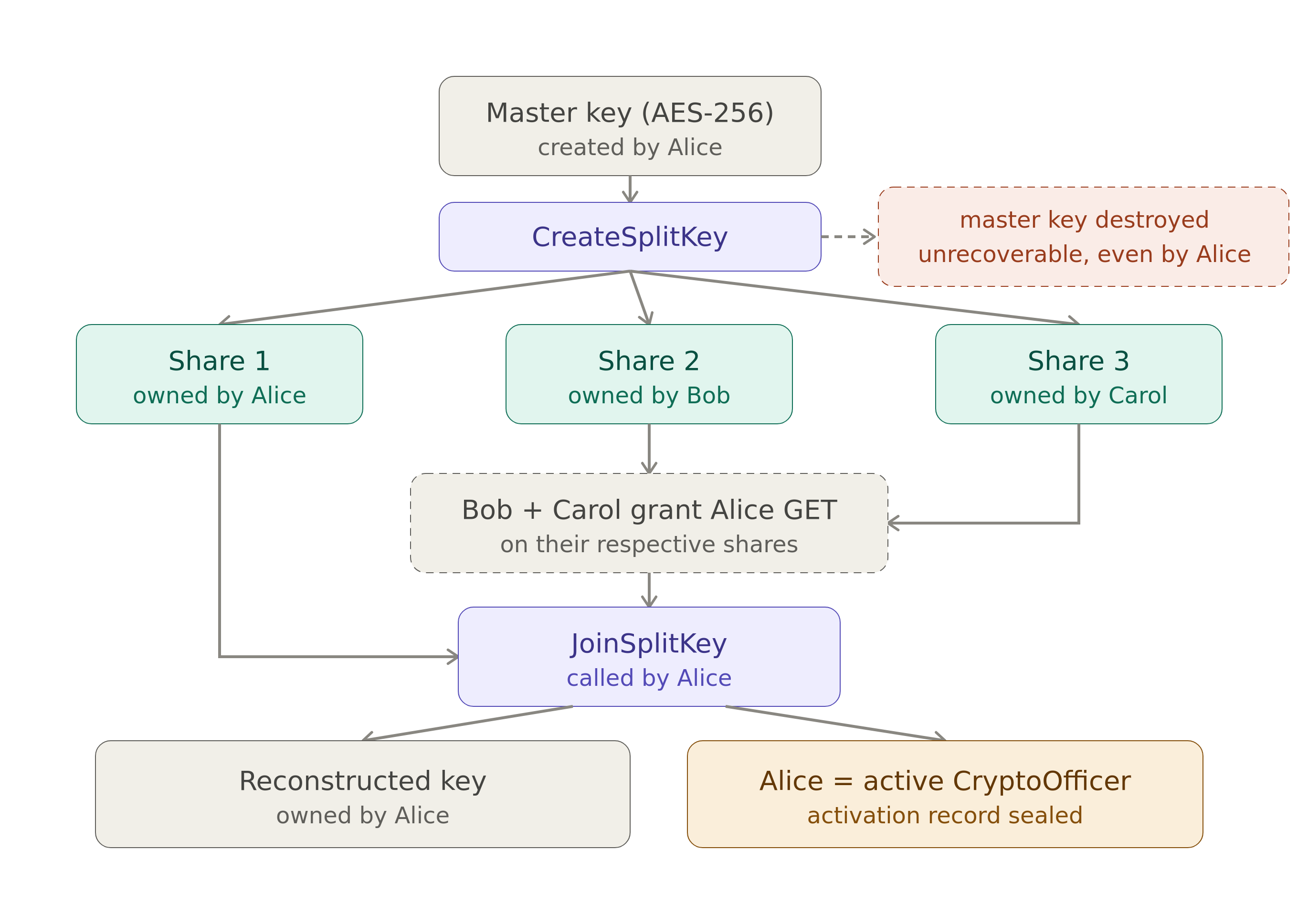
Alice creates the master key and splits it into three shares; the KMS destroys the original immediately, so from that point on not even Alice can recover it alone. Bob and Carol each hold a share Alice does not have. To activate the CryptoOfficer role, Alice needs her own share plus at least one of theirs, which means Bob or Carol must actively grant her access first, so Alice cannot silently activate on her own.
With two custodians, whoever creates the key can always compute the other person's share from the key and their own share, so no real cooperation is required. Three is the minimum where that shortcut disappears, which is why the KMS rejects fewer than 3 custodians at startup.
Phase 1: Provisioning
The number of shares is auto-determined from the crypto_officer_users count, and each
share is auto-assigned to a different CO candidate. No server restart is needed: the
ceremony candidate exemption lets a CO candidate call Create, CreateSplitKey, and
JoinSplitKey even before the ceremony completes, which is what breaks the
chicken-and-egg problem of needing the role to set up the role.
sequenceDiagram
    actor Candidate as CO candidate
    participant KMS

    Candidate->>KMS: Create(AES-256) → key_id
    Candidate->>KMS: SetAttribute(key_id, ceremony=true)
    Candidate->>KMS: CreateSplitKey(key_id)
    KMS-->>Candidate: share_1, share_2, ..., share_n

    Note over Candidate: Distribute shares out-of-band,<br/>ask each CO to grant GET access
Phase 2: Activate Crypto Officer Role (JoinSplitKey)
The CO candidate assembles all $n$ share UIDs (after each other CO grants GET access to their share), then activates via one of two mechanisms, both reachable from the CLI and the Web UI:
- KMIP
JoinSplitKey(ckms sym keys join-split-key, or the Web UI's Join Split Key page): stores the reconstructed key as an Active managed object inobjects, owned by the caller. POST /access/crypto_officer/ceremony/activate(ckms access-rights crypto-officer activate, or the Web UI's Crypto Officer Role page): reconstructs the secret in RAM only to verify its SHA-256 fingerprint, then zeroizes it. No key object is stored.
Both run the same checks first:
- Retrieves each share (the candidate must have
Geton each) and validates them: same ceremony tag, same source key, correct count, and the candidate listed incrypto_officer_users. - Checks that at least one share belongs to a different CO: the activating candidate may own shares, but not all of them. This is what prevents solo self-activation.
Either way, the server persists the crypto_officer_activations record and the candidate
is now an active CryptoOfficer.
JoinSplitKey stores the reconstructed key as a usable KMS object; ceremony/activate
does not — the secret is RAM-only and zeroized immediately after the activation record
is written. Pick based on whether you need the reconstructed key as a managed object
afterward.
sequenceDiagram
    actor Alice as Alice (CO candidate)
    actor Bob as Bob
    actor Carol as Carol
    participant KMS

    Bob->>KMS: GrantAccess(share_1 → Alice, Get)
    Carol->>KMS: GrantAccess(share_3 → Alice, Get)
    Alice->>KMS: JoinSplitKey([share_1, share_2, share_3])
    KMS-->>Alice: Activated, CryptoOfficer role is now ACTIVE
Revoking
Any configured CO candidate may revoke the active CO's ceremony:
| Who calls | Outcome |
|---|---|
| Active CO (currently holds the ceremony) | Immediate self-revoke: 200 OK. |
Any other CO candidate (in crypto_officer_users, not currently active) | Peer revocation: revokes the active CO's role immediately. |
| Any other user | 401 Unauthorized. |
The reconstructed key is NOT revoked; only the crypto_officer_activations row
is updated. The demoted CO retains their reconstructed key as an Operator.
Emergency revocation (config path)
When all CO candidates are unavailable:
- Remove the user from
crypto_officer_usersinkms.toml. - Restart the KMS server.
Quick reference
Permission model
Request: operation OP by user U
│
├─ crypto_officer_users not configured
│  └─ Standard owner/grant check (no role restrictions)
│
└─ crypto_officer_users configured
   │
   ├─ U not in crypto_officer_users
   │  └─ role = Operator (fail-secure default)
   │
   └─ U in crypto_officer_users
      │
      ├─ require_ceremony = false
      │  └─ role = CryptoOfficer: GRANTED
      │           (lifecycle + key output + ownership bypass)
      │
      └─ require_ceremony = true
         │
         ├─ no active row in crypto_officer_activations
         │  └─ role = Operator (dormant until ceremony completes)
         │
         └─ active row in crypto_officer_activations
            └─ role = CryptoOfficer: GRANTED

Once a role is assigned (CryptoOfficer or Operator):
│
└─ OP in the role's allowed operations?
   │
   ├─ No  → DENIED (Unauthorized)
   │
   └─ Yes → handler-level ownership/grant check
      │
      ├─ Denied  → DENIED (Unauthorized)
      └─ Granted → GRANTED
Configuration
[roles]
# ── CryptoOfficer role: key lifecycle management + ownership bypass ─────────
crypto_officer_users = ["key-mgr@example.com"]

# Set to true to require a JoinSplitKey ceremony before the role becomes active.
crypto_officer_require_ceremony = true

# Hex-encoded 32-byte secret for ceremony record encryption (AES-256-GCM).
# Required when crypto_officer_require_ceremony = true.
# Generate with: openssl rand -hex 32
ceremony_secret = "0123456789abcdef0123456789abcdef0123456789abcdef0123456789abcdef"

# (planned) UID of a KMS symmetric key to use as the ceremony sealing key.
# When set, takes precedence over ceremony_secret. Enables key rotation and HSM backing.
# The key must be created before enabling require_ceremony (use config-only mode first).
# ceremony_key_id = "ceremony-seal-2026"
Users not listed in crypto_officer_users automatically receive Operator privileges.
There is no operator_users config key; the Operator role is the implicit
fail-secure default.
CLI
# 1. Create ceremony key (as CO candidate, before ceremony)
ckms sym keys create --id ceremony-key-2026 --number-of-bits 256

# 2. Stamp ceremony marker (using the Crypto Officer Role Web UI page
#    or directly via CLI):
ckms attributes set-attribute ceremony-key-2026 \
  --vendor-id cosmian \
  --attr-name x-cosmian-crypto-officer-ceremony \
  --attr-value true

# 3. Split the key (server auto-assigns shares to CO candidates)
ckms sym keys create-split-key --key-id ceremony-key-2026 --ceremony
# Share count = crypto_officer_users.len() (auto-determined)
# Source key auto-destroyed after split

# 4. Each other CO grants you GET access to their share
#    (run as each other CO candidate):
ckms access-rights grant <your-identity> -i <their-share-uid> get

# 5. Activate: JoinSplitKey IS the activation (no separate step needed)
ckms sym keys join-split-key <share_1_uid> <share_2_uid> <share_3_uid>
# → CO role activated; reconstructed key stored

# 6. Check status
ckms access-rights crypto-officer status

# 7. Revoke (self or peer)
ckms access-rights crypto-officer disable
REST API equivalents
# Status
curl -s https://<kms>/access/crypto_officer/status

# Activate (via JoinSplitKey)
curl -s -X POST https://<kms>/kmip/2_1 \
  -H 'Content-Type: application/json' \
  -d '{"tag":"JoinSplitKey","type":"Structure","value":[
    {"tag":"ObjectType","type":"Enumeration","value":"SymmetricKey"},
    {"tag":"PrivateKeyUniqueIdentifier","type":"TextString","value":"<share_1_uid>"},
    {"tag":"PrivateKeyUniqueIdentifier","type":"TextString","value":"<share_2_uid>"},
    {"tag":"PrivateKeyUniqueIdentifier","type":"TextString","value":"<share_3_uid>"},
    {"tag":"SplitKeyMethod","type":"Enumeration","value":"XOR"}
  ]}'

# Revoke (self or peer)
curl -s -X POST https://<kms>/access/crypto_officer/disable
Role store vs. key store
Important security boundary:
| Store | Written by | Purpose |
|---|---|---|
crypto_officer_activations DB table | JoinSplitKey on ceremony shares, or POST /access/crypto_officer/ceremony/activate | Sole source of truth for CO role status. Sealed with AES-256-GCM under ceremony_secret. |
objects DB table | Every JoinSplitKey call (ceremony and non-ceremony) | Stores the reconstructed key as a managed KMS object owned by the caller. For ceremony shares the key is stored unconditionally before the activation side-effect runs. |
JoinSplitKeyKMIP operation: stores the reconstructed key inobjectsand writes the CO activation record. Suitable when you need the reconstructed key as a usable KMS object.POST /access/crypto_officer/ceremony/activate: reconstructs the secret in RAM only (for hash verification), writes the CO activation record, and does not store a key object.
The x-cosmian-crypto-officer-ceremony tag on shares identifies which shares belong to
a ceremony split. It does NOT grant any privilege. The server checks this tag only
during ceremony activation validation, never for privilege checks. This prevents an
attacker calling Create(key) + SetAttribute(x-cosmian-crypto-officer-ceremony=true)
from escalating to CO role.
Standards this design draws on
This design is inspired by two publications: FIPS 140-3 (cryptographic module role separation) and NIST SP 800-57 Part 2 Rev 1 (split knowledge and dual control as organizational practices to document). Neither standard mandates a specific implementation.