
HSM keys & operations
In addition to managing its keys, Eviden KMS can act as a proxy to an HSM, storing and managing keys within the HSM.
See Algorithm support by model for a per-vendor PKCS#11 algorithm and capability comparison.
The HSM's slot-local object-handle and OAEP hash caches are documented in
Cache mechanisms.
The current implementation reads key metadata from PKCS#11 on demand; it has
no KeyMetadataCache.
HSM keys
HSM keys are prefixed keys. They are created with a unique identifier that is prefixed by the hsm keyword and the
slot number in the form:
hsm::<slot_number>::<key_identifier>
For instance, the key hsm::1::mykey is stored in the HSM slot 1 with the identifier mykey. Technically, the identifier
is stored in the LABEL field of the key object in the HSM.
The PKCS#11 standard does not enforce label uniqueness: multiple key objects can share the same LABEL
in the same slot. Eviden KMS however uses the label as the sole key identifier within a slot, so it requires
labels to be unique per slot per key type. If two objects of the same type share a label in the same slot,
Eviden KMS will return an error when that label is referenced. Always verify that no existing object already
uses a label before creating a new key with pkcs11-tool --list-objects.
Eviden KMS sets both CKA_LABEL and CKA_ID (to the same bytes as the label) on every key it creates in
the HSM. This conforms to PKCS#11 v2.40 and prevents spurious warnings from tools such as
pkcs11-tool --list-objects. Keys provisioned externally (via pkcs11-tool or the HSM vendor software)
should also have CKA_ID set to match the label bytes if they are intended to be used with Eviden KMS.
Non-prefixed keys are considered KMS keys and are stored in the KMS database.
HSM admin
The KMS server maintains a list of HSM admin users that are allowed to create and destroy
objects directly in the HSM. This is configured with the hsm_admin key in kms.toml:
# One or more KMS usernames with HSM admin privileges
hsm_admin = ["alice@example.com", "bob@example.com"]

# Wildcard: any authenticated user becomes an HSM admin
hsm_admin = ["*"]
From the command line, pass one --hsm-admin flag per username (or a single comma-separated value):
# Two explicit admins
cosmian_kms --hsm-admin alice@example.com --hsm-admin bob@example.com ...

# Or via environment variable
KMS_HSM_ADMIN=alice@example.com,bob@example.com cosmian_kms ...
HSM key authorization model
HSM keys follow a stricter permission model than regular KMS keys. The key principles are:
- HSM admins are the only users who can create and destroy HSM keys.
- All HSM admins share ownership of all HSM keys (any admin can grant, revoke, or destroy any HSM key).
- Non-admin users can only use HSM keys they have been explicitly granted operations on.
- The
Getpermission does not act as a wildcard for HSM keys — each operation must be granted individually. - Locate only returns HSM keys the user is authorized to see (all keys for admins, granted keys for non-admins).
- The server KEK (Key Encryption Key) is a shared wrapping resource accessible to all users for wrapping/unwrapping, but direct cryptographic operations on the KEK itself require explicit grants.
Operations by role
| Operation | HSM Admin | Non-admin (granted) | Non-admin (no grant) |
|---|---|---|---|
| Create / CreateKeyPair | ✅ | ❌ | ❌ |
| Destroy | ✅ | ❌ (cannot be granted) | ❌ |
| Locate | All HSM keys | Granted keys only | None |
| Grant / Revoke (access rights) | ✅ (any HSM key) | ❌ | ❌ |
| Encrypt | ✅ | ✅ | ❌ |
| Decrypt | ✅ | ✅ | ❌ |
| Sign | ✅ | ✅ | ❌ |
| SignatureVerify | ✅ | ✅ | ❌ |
| MAC | ✅ | ✅ | ❌ |
| Get / Export | ✅ | ✅ (metadata if sensitive) | ❌ |
| GetAttributes | ✅ | ✅ | ❌ |
| SetAttribute / ModifyAttribute / AddAttribute / DeleteAttribute | ✅ | ✅ | ❌ |
| Revoke (lifecycle state) | ❌ (not supported) | ❌ | ❌ |
Grantable operations on HSM keys
| Operation | Can be granted? | Notes |
|---|---|---|
encrypt | ✅ | Symmetric (AES) and asymmetric (RSA) |
decrypt | ✅ | Symmetric (AES) and asymmetric (RSA) |
sign | ✅ | RSA private keys only |
signature_verify | ✅ | RSA public keys only |
mac | ✅ | Compute a Message Authentication Code using the HSM key |
get | ✅ | Retrieve key material or metadata; also implies export |
export | ✅ | Export key; also implies get |
get_attributes | ✅ | Read KMS metadata |
locate | ✅ | Search visibility for this key |
set_attribute | ✅ | Modify KMS metadata — does not access HSM hardware |
modify_attribute | ✅ | Modify KMS metadata — does not access HSM hardware |
add_attribute | ✅ | Modify KMS metadata — does not access HSM hardware |
delete_attribute | ✅ | Modify KMS metadata — does not access HSM hardware |
destroy | ❌ | Admin-only — irreversible hardware operation |
revoke | ❌ | HSM keys do not support KMIP lifecycle state changes |
create | ❌ | Admin-only — not a per-key grant |
Unlike regular KMS keys, granting Get on an HSM key does not implicitly grant all other operations.
Each operation (Encrypt, Decrypt, Sign, etc.) must be granted individually.
Creating a KMS key wrapped by an HSM key
KMS Keys can be created wrapped by an HSM key, either manually or automatically.
Manually using the CLI
To create a KMS key wrapped by an HSM key, the --wrapping-key-id argument must be used to specify the unique
identifier of the HSM key.
The user creating the key must be the HSM admin (see above) or have been granted the Encrypt operation on the HSM key.
When the server is configured with a key_encryption_key (see Automatically using the server configuration),
that KEK is a shared server resource and can be used as a wrapping key by any authenticated user, not just
the HSM admin. This allows non-admin users to create their own KMS keys wrapped by the server KEK.
For instance, the following command creates a 256-bit AES key wrapped by the HSM RSA (public) key
hsm::4::my_rsa_key_pk:
> ckms sym keys create --algorithm aes --number-of-bits 256 --sensitive \
  --wrapping-key-id hsm::4::my_rsa_key_pk my_sym_key
The symmetric key was successfully generated.
      Unique identifier: my_sym_key
The symmetric key is now stored in the database encrypted (wrapped) by the HSM key. The encryption happened in the HSM.
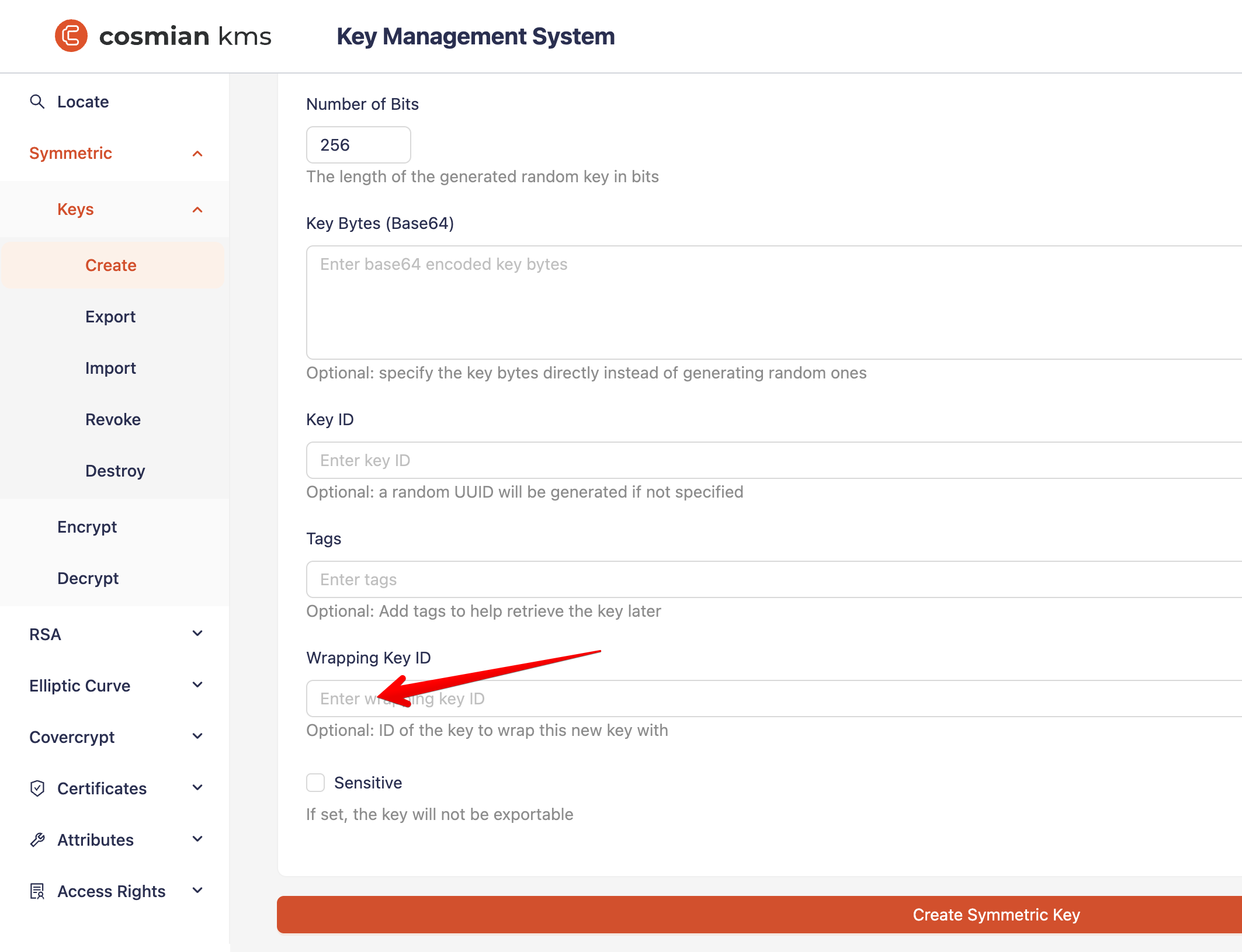
Manually using the Web UI
In the web UI, fill in the Wrapping Key ID field with the unique identifier of the HSM key.
Automatically using the server configuration
The KMS server can automatically wrap all KMS keys with a specific HSM key.
This is done by setting the key_encryption_key property in the TOML server configuration file
or using the corresponding command line switch.
When key_encryption_key is configured, all newly created and imported keys will be automatically wrapped
by the specified Key Encryption Key (KEK), typically an HSM key. Keys are stored wrapped in the KMS database,
ensuring no clear-text key material is persisted.
The server provides selective automatic unwrapping through the default_unwrap_type configuration parameter.
This controls which KMIP object types are automatically unwrapped when retrieved via Get or Export operations:
- Valid values:
["PrivateKey", "PublicKey", "SymmetricKey", "SecretData"] - Default:
[](no automatic unwrapping) - When a
key_encryption_keyis set, it's common to configuredefault_unwrap_type = ["SymmetricKey", "SecretData"]
Example configuration:
# Force all keys to be wrapped by an HSM key
key_encryption_key = "hsm::4::master_kek"

# Automatically unwrap symmetric keys and secret data when retrieved
default_unwrap_type = ["SymmetricKey", "SecretData"]
When an object matching the configured types is retrieved, it is automatically unwrapped and cached in the server's memory cache (see The Unwrapped Objects Cache). This enables transparent encryption/decryption operations without storing clear-text keys in the database while minimizing HSM calls through expiring caching.
Using the wrapped KMS key
The symmetric key created above can now be used to encrypt and decrypt data, and the KMS will transparently unwrap the key using the HSM key.
This unwrapping will happen once, and the unwrapped symmetric key will be cached in memory for later operations; no clear-text symmetric key will be stored in the KMS database.
Small data: encrypting server-side
For example, to encrypt a message with the key my_sym_key server-side, the following command can be used:
> ckms sym encrypt --key-id my_sym_key /tmp/secret.txt
The encrypted file is available at "/tmp/secret.enc"
To decrypt a message with the key my_sym_key, the following command can be used:
> ckms sym decrypt --key-id my_sym_key --output-file /tmp/secret.recovered.txt /tmp/secret.enc
The decrypted file is available at "/tmp/secret.recovered.txt"
Large data: encrypting client side with key wrapping
To encrypt a large file with the key my_sym_key client side, the following command can be used:
>ckms sym encrypt --key-id my_sym_key_2 --data-encryption-algorithm aes-gcm \
--key-encryption-algorithm rfc5649 /tmp/large.bin
The encrypted file is available at "/tmp/large.enc"
In this case, an ephemeral symmetric key (the Data Encryption Key, DEK) is generated and used to encrypt the data.
The DEK is then encrypted/wrapped with RFC4659 (a.k.a NIST AES Key Wrap) with the key my_sym_key,
called the Key Encryption Key, KEK.
The wrapping of the DEK by the KEK is stored at the beginning of the encrypted file.
At rest, in the KMS database, my_sym_key is stored encrypted/wrapped with the HSM key hsm::4::my_rsa_key_pk.
To decrypt a large file with the KEK my_sym_key client side, the following command can be used:
> ckms sym decrypt --key-id my_sym_key_2 --data-encryption-algorithm aes-gcm \
  --key-encryption-algorithm rfc5649 --output-file /tmp/large.recovered.bin /tmp/large.enc
The decrypted file is available at "/tmp/large.recovered.bin"
Unwrapping a KMS-wrapped key from a file
If a KMS key was exported in wrapped KMIP JSON TTLV format (for example, via ckms sym keys export without --unwrap),
it can later be unwrapped using ckms sym keys unwrap.
When the unwrapping key is an HSM key (identified by the hsm:: prefix), the KMS performs the unwrap
server-side using its crypto oracle: the wrapped file is imported to the KMS with key_wrap_type=NotWrapped,
the server decrypts it using the HSM key, and the result is exported back to the output file.
This is transparent to the caller and works even when the HSM key is marked sensitive (non-extractable).
# Export a wrapped DEK to disk
ckms sym keys export --key-id my_sym_key /tmp/my_sym_key_wrapped.json

# Unwrap it using the HSM KEK — the KMS handles the decryption server-side
ckms sym keys unwrap --unwrap-key-id hsm::4::master_kek \
  /tmp/my_sym_key_wrapped.json /tmp/my_sym_key_unwrapped.json
The Unwrapped Objects Cache
The unwrapped cache is a memory cache, and it is not persistent. The unwrapped cache is used to store unwrapped objects that are fetched from the database.
When a wrapped object is fetched from the database, it is unwrapped and stored in the unwrapped cache. Further calls to the same object will use the unwrapped object from the cache until the cache expires.
The time in minutes after an unused object is evicted from the cache is configurable
using the unwrapped_cache_max_age setting. The default is 15 minutes.
When HSM keys wrap objects, a long expiration time reduces the number of calls made to the HSM to unwrap the object. However, increasing the cache time will increase the memory the KMS server uses and expose the key in clear text in the memory for a longer time.
HSM KMIP operations
Some KMIP operations can be performed directly via the KMS server API on the HSM keys.
Create
Create a new key in the HSM. The key unique must be provided on the request and must follow the
hsm::<slot_number>::<key_identifier> format described above.
Only HSM admin users can create keys directly in the HSM (see HSM admin above).
RSA and AES keys are supported.
When creating an RSA key, the key_identifier will be that of the private key. The corresponding public key will be
automatically created and stored in the HSM with the same key_identifier but with the _pk suffix, for example,
the public key of the hsm::1::mykey private key will be created with a unique identifier hsm::1::mykey_pk.
Create an RSA 4096-bit key on the HSM slot 4, with the KMS CLI:
❯ ckms rsa keys create --size_in_bits 4096 hsm::4::my_rsa_key
The RSA key pair has been created.
      Public key unique identifier: hsm::4::my_rsa_key_pk
      Private key unique identifier: hsm::4::my_rsa_key
Create an AES 256-bit key on HSM slot 4, with the KMS CLI:
❯ ckms sym keys create --algorithm aes --number-of-bits 256 hsm::4::my_aes_key
The symmetric key was successfully generated.
   Unique identifier: hsm::4::my_aes_key
Elliptic curve key pairs can also be created directly on the HSM, using the same ec keys create CLI command as for software keys. The FIPS-approved NIST curves supported by the HSM
integration are P-256 (default), P-384, and P-521 — the same curves accepted by
--curve nist-p256/nist-p384/nist-p521. With the non-fips build feature,
Ed25519 and Ed448 (for EdDSA signing) and X25519 (for ECDH key agreement) are also
supported — see HSM-delegated EdDSA signing below. X448 and the non-FIPS NIST
curves (secp256k1, secp224k1) remain unsupported by the HSM delegation and are
software-only.
Create an EC P-384 key pair on HSM slot 4, with the KMS CLI:
❯ ckms ec keys create --curve nist-p384 hsm::4::my_ec_key
The EC key pair has been created.
      Public key unique identifier: hsm::4::my_ec_key_pk
      Private key unique identifier: hsm::4::my_ec_key
HSM keys are always created with CKA_SENSITIVE=true (private/symmetric key material cannot be
exported). Pass --sensitive false explicitly only if you intentionally need an extractable key.
Note: HSM keys do not support object tagging in this release.
Using pkcs11-tool directly
Keys can also be provisioned directly in the HSM with pkcs11-tool (part of OpenSC), bypassing the Eviden KMS
entirely. This is useful for pre-provisioning a master KEK before the KMS server starts, or for HSM models where
the Eviden PKCS#11 integration does not yet support key generation.
The LABEL set with --label becomes the <key_identifier> part of the Eviden KMS unique identifier
hsm::<slot_number>::<label>.
Step 1 — List available slots
pkcs11-tool --module /tw/oemDist/libnethsmpkcs11.so --list-slots
Step 2 — Create an AES key
--key-type AES:<bytes> — size in bytes (16 = 128-bit, 24 = 192-bit, 32 = 256-bit).
# AES-128 key on slot 1, label "master_kek"
pkcs11-tool --module /tw/oemDist/libnethsmpkcs11.so \
  --slot 1 \
  --key-type AES:16 \
  --keygen \
  --label master_kek

# AES-256 key on slot 1, label "data_kek"
pkcs11-tool --module /tw/oemDist/libnethsmpkcs11.so \
  --slot 1 \
  --key-type AES:32 \
  --keygen \
  --label data_kek
If the slot requires a PIN, add --login --pin <PIN> (or --login alone to be prompted interactively):
pkcs11-tool --module /tw/oemDist/libnethsmpkcs11.so \
  --slot 1 \
  --login --pin 1234 \
  --key-type AES:32 \
  --keygen \
  --label data_kek
Step 3 — Create an RSA key pair
# RSA-4096 key pair on slot 4, label "my_rsa_key"
pkcs11-tool --module /tw/oemDist/libnethsmpkcs11.so \
  --slot 4 \
  --login --pin 1234 \
  --key-type RSA:4096 \
  --keypairgen \
  --label my_rsa_key
The private key label becomes hsm::4::my_rsa_key in Eviden KMS. For RSA key pairs, Eviden KMS
appends _pk to the label to build the public key identifier: hsm::4::my_rsa_key_pk.
Step 4 — Verify the objects are visible
Always check for existing objects with the same label before creating a new key — Eviden KMS requires labels to be unique within a slot and key type:
pkcs11-tool --module /tw/oemDist/libnethsmpkcs11.so \
  --slot 1 \
  --list-objects
The AES key created above will then be addressable in Eviden KMS as hsm::1::master_kek
and can immediately be used as a KEK:
# kms.toml
key_encryption_key = "hsm::1::master_kek"
Destroy
Unlike KMS keys, HSM keys must not be revoked before being destroyed. The Destroy operation will remove the
key from the HSM.
Only HSM admin users can destroy keys in the HSM. The Destroy operation cannot be delegated to non-admin users.
To destroy the key hsm::4::my_rsa_key, the following command can be used:
❯ ckms rsa keys destroy --key-id hsm::4::my_rsa_key
Successfully destroyed the key.
      Unique identifier: hsm::4::mykey
To destroy the corresponding public key hsm::4::my_rsa_key_pk, the following command can be used:
❯ ckms rsa keys destroy --key-id hsm::4::my_rsa_key_pk
Successfully destroyed the object.
   Unique identifier: hsm::4::my_rsa_key_pk
Get - Export
The Get and Export operations are used to retrieve the key material from the HSM.
Only HSM admin users, or a user granted the Get operation by an HSM admin, can retrieve keys from the HSM.
Private or symmetric keys marked as sensitive cannot be retrieved from the HSM.
The public key of a key pair can always be retrieved.
To export the public key hsm::4::my_rsa_key_pk in PKCS#8 PEM format, the following command can be used:
❯ ckms rsa keys export --key-id hsm::4::my_rsa_key_pk --key-format pkcs8-pem /tmp/pubkey.pem
The key hsm::4::my_rsa_key_pk of type PublicKey was exported to "/tmp/pubkey.pem"
   Unique identifier: hsm::4::my_rsa_key_pk
To export the private key hsm::4::mykey in PKCS#8 PEM format, the following command can be used:
❯ ckms rsa keys export --key-id hsm::4::my_rsa_key --key-format pkcs8-pem /tmp/privkey.pem
The key hsm::4::my_rsa_key of type PrivateKey was exported to "/tmp/privkey.pem"
   Unique identifier: hsm::4::my_rsa_key
To export the symmetric key hsm::4::my_aes_key in raw format (i.e., raw bytes),
the following command can be used:
❯ ckms sym keys export --key-id hsm::4::my_aes_key --key-format raw /tmp/symkey.raw
The key hsm::4::my_aes_key of type SymmetricKey was exported to "/tmp/symkey.raw"
   Unique identifier: hsm::4::my_aes_key
Encrypt
Symmetric keys and public keys can be used to encrypt data. Only HSM admin users, or a user granted the Encrypt
operation by an HSM admin, can encrypt data with keys stored in the HSM.
For symmetric keys, only AES GCM is supported. CKM_RSA_PKCS_OAEP and the now-deprecated, but still widely used, CKM_RSA_PKCS (v1.5) are supported for RSA keys. The hashing algorithm is fixed to SHA256.
When using RSA, the maximum message size in bytes is:
- PKCS#1 v1.5: (key size in bits / 8) - 11
- OAEP: (key size in bits / 8) - 66
To encrypt a message with the public key hsm::4::my_rsa_key_pk and the CKM RSA PKCS OAEP algorithm, the following
command can be used:
❯ ckms rsa encrypt --key-id hsm::4::my_rsa_key_pk --encryption-algorithm ckm-rsa-pkcs-oaep \
/tmp/secret.txt
The encrypted file is available at "/tmp/secret.enc"
To encrypt a message using AES GCM with the symmetric key hsm::4::my_aes_key, the following command can be used:
❯ ckms sym encrypt --key-id hsm::4::my_aes_key --data-encryption-algorithm aes-gcm /tmp/secret.txt
The encrypted file is available at "/tmp/secret.enc"
Decrypt
Symmetric keys and private keys can be used to decrypt data. Only HSM admin users, or a user granted the Decrypt
operation by an HSM admin, can decrypt data with keys stored in the HSM.
For symmetric keys, only AES GCM is supported. CKM_RSA_PKCS_OAEP and the now-deprecated, but still widely used, CKM_RSA_PKCS (v1.5) are supported for RSA keys. The hashing algorithm is fixed to SHA256.
To decrypt a message with the private key
key hsm::4::hsm::4::my_rsa_key and the CKM RSA PKCS OAEP algorithm, the following command can be used:
❯ ckms rsa decrypt --key-id hsm::4::my_rsa_key --encryption-algorithm ckm-rsa-pkcs-oaep \
  --output-file /tmp/secret.recovered.txt /tmp/secret.enc
The decrypted file is available at "/tmp/secret.plain"
To decrypt a message using AES GCM with the symmetric key hsm::4::my_aes_key, the following command can be used:
> ckms sym decrypt --key-id hsm::4::my_aes_key --data-encryption-algorithm aes-gcm \
  --output-file /tmp/secret.recovered.txt /tmp/secret.enc
The decrypted file is available at "/tmp/secret.recovered.txt"
Sign
RSA and EC private keys can be used to sign data. Only HSM admin users, or a user granted the
Sign operation by an HSM admin, can sign data with keys stored in the HSM.
Two families of RSA signing mechanisms are supported:
- PKCS#1 v1.5 (
CKM_SHA{1,256,384,512}_RSA_PKCS): deterministic, the classic RSA signature scheme. - RSASSA-PSS (
CKM_SHA{256,384,512}_RSA_PKCS_PSS): the probabilistic scheme recommended by current standards (e.g. FIPS 186-5, RFC 8017). The salt length defaults to the digest length in bytes (32 for SHA-256, 48 for SHA-384, 64 for SHA-512) and can be overridden via the KMIPCryptographicParameters.salt_lengthfield;salt_length: 0produces a deterministic PSS signature.
The ckms rsa sign CLI command always uses RSASSA-PSS with SHA-256, matching the KMS software
signing path. To sign a file with the HSM-resident private key hsm::4::my_rsa_key, the following
command can be used:
❯ ckms rsa sign --key-id hsm::4::my_rsa_key -o /tmp/secret.sig /tmp/secret.txt
The signature is available at "/tmp/secret.sig"
RSA-PSS signing over HSM-resident keys is delegated end-to-end to the PKCS#11 device: the
private key never leaves the HSM, and the PSS mechanism parameters (hash algorithm, MGF1
hash algorithm, salt length) are built from the KMIP request and passed directly to
C_Sign via CK_RSA_PKCS_PSS_PARAMS. When the KMIP request carries digested_data, the KMS
uses raw CKM_RSA_PKCS_PSS so the supplied digest is signed directly; otherwise it uses the
matching CKM_SHA{256,384,512}_RSA_PKCS_PSS mechanism. This is purely additive: existing
PKCS#1 v1.5 and OAEP mechanisms, key types, and HSM vendor loaders are unaffected. See
ADR-2026-09-05 for the scope
decision.
ECDSA signing over an HSM-resident EC private key uses the same ec sign CLI command as the
software signing path. The CLI now sends curve-appropriate KMIP CryptographicParameters
automatically (P-256 → ECDSAWithSHA256, P-384 → ECDSAWithSHA384, P-521 → ECDSAWithSHA512),
and the HSM path dispatches them to C_Sign with CKM_ECDSA_SHA{256,384,512}. When --digested
is used, the server switches to raw CKM_ECDSA so the supplied digest is signed directly instead
of being hashed a second time.
To sign a file with the HSM-resident EC private key hsm::4::my_ec_key, the following command
can be used:
❯ ckms ec sign --key-id hsm::4::my_ec_key -o /tmp/secret.sig /tmp/secret.txt
The signature is available at "/tmp/secret.sig"
ECDSA signing over HSM-resident EC keys is delegated end-to-end to the PKCS#11 device: the
private key never leaves the HSM. PKCS#11 ECDSA signatures are the raw, fixed-length r‖s
concatenation; the KMS converts this to the DER SEQUENCE { r, s } encoding expected
elsewhere in the codebase before returning the signature. Depending on the HSM and mechanism
implementation, ECDSA signatures may be randomized or deterministic (for example RFC 6979);
both behaviors are valid as long as the returned signature verifies. This is purely additive:
existing RSA signing mechanisms, key types, and HSM vendor loaders are unaffected. See
ADR-2026-09-06 for
implementation details and the PBKDF2 deferral rationale (SoftHSM2, the only backend
available for end-to-end validation in this environment, does not implement
CKM_PKCS5_PBKD2).
EdDSA signing (Ed25519/Ed448) over an HSM-resident Edwards-curve private key is available with
the non-fips build feature, using the same ec sign CLI command as ECDSA above. Unlike ECDSA,
EdDSA is a pure, un-hashed signature scheme (RFC 8032): the raw message is passed directly to
C_Sign with CKM_EDDSA, with no digest step and no DER re-encoding.
❯ ckms ec keys create --curve ed25519 hsm::4::my_ed25519_key
The EC key pair has been created.
      Public key unique identifier: hsm::4::my_ed25519_key_pk
      Private key unique identifier: hsm::4::my_ed25519_key

❯ ckms ec sign --key-id hsm::4::my_ed25519_key -o /tmp/secret.sig /tmp/secret.txt
The signature is available at "/tmp/secret.sig"
EdDSA signing over HSM-resident Ed25519/Ed448 keys is delegated end-to-end to the PKCS#11
device via CKM_EC_EDWARDS_KEY_PAIR_GEN (key generation) and CKM_EDDSA (signing). Unlike
ECDSA, EdDSA is deterministic: signing the same data twice with the same key always
produces the same signature. Gated behind the non-fips build feature, mirroring the
existing software EdDSA gating in crate::crypto::elliptic_curves::sign — HKDF and SP
800-108 KDF are NIST-approved and not affected by this flag. Validated live against a
SoftHSM2 2.6.1 token. HSM-delegated X25519 key generation
(CKM_EC_MONTGOMERY_KEY_PAIR_GEN) is also implemented, but X25519 ECDH key agreement
(DeriveKey), HKDF/SP 800-108 key derivation, and message-based AEAD are not yet
implemented — no PKCS#11 backend available in this environment (SoftHSM2, the Utimaco
CryptoServer simulator) exposes the required mechanisms for end-to-end validation. This
remains open, tracked on
issue #1157.
PKCS#11 protocol version compatibility
Eviden KMS talks to HSMs over Cryptoki (PKCS#11) v2.40 on the consumer side (crate/hsm/base_hsm
and its vendor loaders: SoftHSM2, Utimaco, Proteccio, Crypt2Pay, SmartCard HSM, AWS CloudHSM). Every Cryptoki
function (C_Initialize, C_GetInfo, C_Encrypt, ...) is resolved by its stable C symbol name,
never through the PKCS#11 v3.0 "interfaces" discovery mechanism
(C_GetInterfaceList/C_GetInterface). This means any v2.40-compliant HSM library works out of
the box, and this behavior is unaffected regardless of whether the library also happens to support
v3.0.
Eviden KMS uses the canonical v3 bindings supplied by pkcs11-sys to optionally detect
whether the loaded PKCS#11 library exposes the v3
interfaces discovery entry point (C_GetInterfaceList), without changing how any function is
resolved or called. This is a read-only capability probe for diagnostics — a v2.40-only
library simply does not export C_GetInterfaceList, so the probe reports "not
supported" and nothing else changes; a v3-capable library additionally reports the list of
interfaces it exposes (e.g. "PKCS 11"). See
ADR-2026-09-03 for the full
scope decision and rationale.
Supported operations and mechanisms
The tables below enumerate every mechanism/operation category defined by the OASIS PKCS#11
v2.40 and v3.0 specifications (Cryptoki mechanisms table, PKCS11-Curr-v2.40 §12 and
PKCS11-Curr-v3.0 §2/§6), and mark, per the actual source code, which are supported by:
- KMS server — Eviden KMS acting as a PKCS#11 consumer/client of a vendor HSM
(
crate/hsm/base_hsm), delegating KMIP operations toC_*calls against the loaded vendor library. cosmian_pkcs11— thelibcosmian_pkcs11provider DLL (documented in full on the PKCS#11 provider module page), which exposes KMS-managed keys as a Cryptoki token to third-party applications — the opposite PKCS#11 role.
✅ supported · ⚠️ partially supported (see Notes) · ❌ not supported · ➖ not applicable to this role
Random number generation
| Function | Ver. | KMS server | cosmian_pkcs11 | Notes |
|---|---|---|---|---|
C_GenerateRandom | v2.40 | ✅ delegated to the HSM's own RNG | ✅ system CSPRNG (rand::rng()), not HSM-backed | — |
C_SeedRandom | v2.40 | ➖ (HSM's own RNG is not re-seedable through base_hsm) | ❌ always returns CKR_RANDOM_NO_RNG | the provider's OS-backed CSPRNG does not accept caller seed material |
Object management — symmetric key generation (§6.31 v2.40, §2.3 v3.0)
| Mechanism | Ver. | KMS server: parameters | cosmian_pkcs11 | Notes |
|---|---|---|---|---|
CKM_AES_KEY_GEN | v2.40 | ✅ AES-128 or AES-256 (CKA_VALUE_LEN 16/32 bytes) | ❌ | provider: C_GenerateKeyPair/C_GenerateKey for secret keys stubbed except the CKM_AES_KEY_GEN mapping used internally by C_GenerateKey's KeyAlgorithm conversion (keys are still created via KMIP Create, not through this provider's PKCS#11 surface) |
CKM_GENERIC_SECRET_KEY_GEN | v3.0 | ✅ CKK_GENERIC_SECRET, arbitrary length (HKDF IKM) | ❌ | FIPS-eligible (not gated) |
CKM_DES_KEY_GENCKM_DES2_KEY_GENCKM_DES3_KEY_GEN | v2.40 | ❌ | ❌ | not implemented (deprecated algorithm) |
CKM_RC2_KEY_GENCKM_RC4_KEY_GENCKM_RC5_KEY_GENCKM_CAST_KEY_GENCKM_CAST3_KEY_GENCKM_CAST128_KEY_GENCKM_IDEA_KEY_GENCKM_CDMF_KEY_GENCKM_BLOWFISH_KEY_GENCKM_CAMELLIA_KEY_GENCKM_SEED_KEY_GEN | v2.40 | ❌ | ❌ | legacy/vendor ciphers, not implemented |
CKM_GOST28147_KEY_GEN | v2.40 | ❌ | ❌ | not implemented (Russian GOST cryptosystem) |
Object management — asymmetric key-pair generation (§6.31 v2.40, §2.3 v3.0)
| Mechanism | Ver. | KMS server: parameters | cosmian_pkcs11 | Notes |
|---|---|---|---|---|
CKM_RSA_PKCS_KEY_PAIR_GEN | v2.40 | ✅ CKA_MODULUS_BITS ∈ {1024, 2048, 3072, 4096}, CKA_PUBLIC_EXPONENT fixed 0x010001 (65537) | ❌ | keys created via the KMIP CreateKeyPair API, then discovered by the provider |
CKM_RSA_X9_31_KEY_PAIR_GEN | v2.40 | ❌ | ❌ | not implemented |
CKM_EC_KEY_PAIR_GEN (NIST prime curves) | v2.40 | ✅ P-224/P-256/P-384/P-521, CKA_EC_PARAMS = DER OBJECT IDENTIFIER | ❌ (recognized for sign/verify only, see below) | secp256k1/secp224k1 (SECG Koblitz) explicitly rejected on the KMS side (curve_from_der_oid, issue #1157) |
CKM_DSA_KEY_PAIR_GENCKM_DSA_PARAMETER_GEN | v2.40 | ❌ | ❌ | not implemented (deprecated algorithm) |
CKM_DH_PKCS_KEY_PAIR_GENCKM_DH_PKCS_PARAMETER_GEN | v2.40 | ❌ | ❌ | not implemented (classic Diffie-Hellman) |
CKM_X9_42_DH_KEY_PAIR_GENCKM_X9_42_DH_PARAMETER_GEN | v2.40 | ❌ | ❌ | not implemented |
CKM_GOST3410_KEY_PAIR_GEN | v2.40 | ❌ | ❌ | not implemented (Russian GOST cryptosystem) |
CKM_EC_EDWARDS_KEY_PAIR_GEN | v3.0 | ✅ Ed25519 (non-fips)/Ed448 (non-fips); CKA_EC_PARAMS encoded as a PrintableString curve name (empirically required by SoftHSM2 2.6.1, not the OID form) | ❌ | capability-gated: attempted best-effort, degrades gracefully if the loaded library lacks the mechanism |
CKM_EC_MONTGOMERY_KEY_PAIR_GEN | v3.0 | ✅ X25519 (non-fips), CKA_DERIVE set instead of CKA_SIGN/CKA_VERIFY | ❌ | keygen only — C_DeriveKey/ECDH not yet wired (#1157) |
Symmetric encryption and decryption (§6.3 v2.40, §5.20-5.21 v3.0)
| Mechanism | Ver. | KMS server: parameters | cosmian_pkcs11: parameters | Notes |
|---|---|---|---|---|
CKM_AES_GCM | v2.40 | ✅ random 96-bit IV per call; no AAD (ulAADLen always 0); fixed 128-bit tag, ciphertext‖tag layout | ✅ caller-supplied IV 1–128 bytes; caller-supplied AAD 0–1 MiB; tag must be exactly 128 bits (rejected otherwise); ciphertext‖tag layout; single-shot only (C_EncryptUpdate/C_EncryptFinal multi-part stubbed) | provider AES-GCM is implemented in the KMS crypto backend, not delegated to a vendor HSM |
CKM_AES_CBC | v2.40 | ✅ random 16-byte IV; software PKCS#7 padding applied before C_Encrypt; multi-round chaining above max_cbc_data_size | ✅ caller-supplied 16-byte IV, unpadded | — |
CKM_AES_CBC_PAD | v2.40 | ❌ (padding done in software, see above) | ✅ caller-supplied 16-byte IV, native PKCS#7 padding | — |
CKM_AES_ECBCKM_AES_CTRCKM_AES_CFB{8,64,128}CKM_AES_OFBCKM_AES_CCMCKM_AES_CTS | v2.40 | ❌ | ❌ | not implemented |
CKM_DES_ECBCKM_DES_CBCCKM_DES_CBC_PADCKM_DES3_ECBCKM_DES3_CBCCKM_DES3_CBC_PADCKM_DES_CFB{8,64}CKM_DES_OFB64 | v2.40 | ❌ | ❌ | not implemented (deprecated algorithm) |
CKM_RC2_*CKM_RC4CKM_RC5_*CKM_CAST_*CKM_CAST3_*CKM_CAST128_*CKM_IDEA_*CKM_CDMF_*CKM_BLOWFISH_CBCCKM_CAMELLIA_*CKM_SEED_*CKM_GOST28147_ECBCKM_GOST28147 | v2.40 | ❌ | ❌ | legacy/vendor ciphers, not implemented |
Asymmetric encryption and decryption (§6.4 v2.40)
| Mechanism | Ver. | KMS server: parameters | cosmian_pkcs11 | Notes |
|---|---|---|---|---|
CKM_RSA_PKCS | v2.40 | ✅ RSA PKCS#1 v1.5 encrypt/decrypt, no parameters | ❌ (sign/verify only, see below) | — |
CKM_RSA_PKCS_OAEP | v2.40 | ✅ SHA-1/MGF1-SHA1 or SHA-256/MGF1-SHA256 (CK_RSA_PKCS_OAEP_PARAMS, empty source data); also used via C_WrapKey/C_UnwrapKey to wrap AES KEKs | ❌ | not implemented on the provider side |
CKM_RSA_X_509 (raw RSA) | v2.40 | ❌ | ❌ | not implemented |
Signatures and MACs (§6.4-6.5 v2.40, §2.3.9 v3.0)
| Mechanism | Ver. | KMS server: algorithm & parameters | cosmian_pkcs11: algorithm & parameters | Notes |
|---|---|---|---|---|
CKM_RSA_PKCS (raw) | v2.40 | ✅ RSA PKCS#1 v1.5 over a caller-supplied DigestInfo (SHA-1/256/384/512 OID prefix) | ✅ raw PKCS#1 v1.5 | — |
CKM_SHA{1,256,384,512}_RSA_PKCS | v2.40 | ✅ RSA PKCS#1 v1.5, hash computed by the HSM | ✅ same 4 hashes | CKM_SHA224_RSA_PKCS/CKM_MD5_RSA_PKCS not implemented on either side |
CKM_RSA_PKCS_PSS | v2.40 | ✅ hash ∈ {SHA-256, SHA-384, SHA-512}, independent MGF1 hash, explicit salt length (CK_RSA_PKCS_PSS_PARAMS) | ✅ hash & MGF1 ∈ {SHA-1, SHA-224, SHA-256, SHA-384, SHA-512} (any combination), explicit salt length; operates on a pre-hashed digest per §6.4.7 | — |
CKM_SHA{256,384,512}_RSA_PKCS_PSS | v2.40 | ✅ combined hash-then-PSS-sign in one call | ➖ (provider always uses the pre-hashed CKM_RSA_PKCS_PSS form) | — |
CKM_RSA_X_509 (raw sign/verify) / CKM_RSA_9796 | v2.40 | ❌ | ❌ | not implemented |
CKM_ECDSA (raw digest) | v2.40 | ✅ NIST P-256/P-384/P-521, raw r‖s re-encoded to DER ECDSA-Sig-Value | ✅ NIST P-256/P-384/P-521 + secp256k1 (non-FIPS) | KMS: secp256k1 explicitly rejected; provider: usable for sign/verify against KMS-generated secp256k1 keys |
CKM_ECDSA_SHA{1,224,256,384,512} | v2.40 | ✅ (SHA-256/384/512 only) hash-then-sign in one call | ❌ (provider hashes client-side, then uses raw CKM_ECDSA) | — |
CKM_DSACKM_DSA_SHA{1,224,256,384,512} | v2.40 | ❌ | ❌ | not implemented (deprecated algorithm) |
CKM_MD2_HMACCKM_MD5_HMACCKM_SHA_1_HMACCKM_SHA224_HMACCKM_SHA256_HMACCKM_SHA384_HMACCKM_SHA512_HMAC | v2.40 | ❌ | ❌ | not implemented |
CKM_AES_CMACCKM_AES_CMAC_GENERALCKM_DES3_CMACCKM_DES3_CMAC_GENERAL | v2.40 | ❌ | ❌ | not implemented |
CKM_GOST3410_WITH_GOSTR3411 | v2.40 | ❌ | ❌ | not implemented (Russian GOST cryptosystem) |
CKM_EDDSA | v3.0 | ✅ Ed25519/Ed448 (non-fips), pure un-hashed signing (RFC 8032); pParameter omitted (NULL) to select plain Ed25519, not Ed25519ctx | ✅ Ed25519/Ed448, same pure un-hashed convention | capability-gated on the KMS side |
C_MessageSignInitC_SignMessageC_MessageSignFinal | v3.0 | ➖ | ✅ EdDSA (Ed25519/Ed448) only | provider-only concept (message-based split flow); not applicable to the KMS-as-consumer role |
C_MessageVerifyInitC_VerifyMessageC_MessageVerifyFinal | v3.0 | ➖ | ❌ | present in the v3.0 function list but stubbed on the provider side |
Message digesting (§6.2 v2.40, §2.1 v3.0)
| Mechanism | Ver. | KMS server | cosmian_pkcs11 | Notes |
|---|---|---|---|---|
C_Digest with CKM_MD2CKM_MD5CKM_SHA_1CKM_SHA224CKM_SHA256CKM_SHA384CKM_SHA512CKM_SHA512_224CKM_SHA512_256CKM_RIPEMD128CKM_RIPEMD160 (standalone) | v2.40 | ❌ | ❌ stubbed (C_Digest family) | hash mechanisms are used internally only, as parameters to RSA-OAEP/PSS and "hash-and-sign" mechanisms; no standalone digest operation is exposed on either side |
CKM_SHA3_224CKM_SHA3_256CKM_SHA3_384CKM_SHA3_512CKM_SHAKE_128CKM_SHAKE_256 | v3.0 | ❌ | ❌ | not implemented |
CKM_GOSTR3411 | v2.40 | ❌ | ❌ | not implemented (Russian GOST hash) |
Key derivation (§6.30 v2.40, §2.5 v3.0)
| Mechanism | Ver. | KMS server: parameters | cosmian_pkcs11 | Notes |
|---|---|---|---|---|
CKM_HKDF_DERIVECKM_HKDF_DATA | v3.0 | ⚠️ HKDF-Extract-and-Expand, PRF hash ∈ {SHA-256, SHA-384, SHA-512}, optional salt (CK_HKDF_PARAMS), base key must be CKK_GENERIC_SECRET — implemented in base_hsm (derive_hkdf_key), not yet KMIP-reachable (#1182) | ❌ | provider: C_DeriveKey stubbed |
CKM_ECDH1_DERIVECKM_ECDH1_COFACTOR_DERIVECKM_ECMQV_DERIVE | v2.40/v3.0 | ❌ (X25519 keygen exists but ECDH derive is not wired) | ❌ | not implemented on either side |
CKM_DH_PKCS_DERIVECKM_X9_42_DH_DERIVECKM_X9_42_DH_HYBRID_DERIVECKM_X9_42_MQV_DERIVE | v2.40 | ❌ | ❌ | not implemented |
CKM_SSL3_MASTER_KEY_DERIVECKM_SSL3_KEY_AND_MAC_DERIVECKM_TLS_MASTER_KEY_DERIVECKM_TLS_KEY_AND_MAC_DERIVECKM_TLS12_MASTER_KEY_DERIVECKM_TLS12_KEY_AND_MAC_DERIVECKM_TLS_KDF | v2.40 | ❌ | ❌ | not implemented (TLS/SSL session-key derivation) |
CKM_CONCATENATE_BASE_AND_KEYCKM_CONCATENATE_BASE_AND_DATACKM_CONCATENATE_DATA_AND_BASECKM_XOR_BASE_AND_DATACKM_EXTRACT_KEY_FROM_KEYCKM_AES_CBC_ENCRYPT_DATACKM_DES3_CBC_ENCRYPT_DATA | v2.40 | ❌ | ❌ | key-derivation utility mechanisms, not implemented |
CKM_PKCS5_PBKD2 | v2.40 | ❌ | ❌ | not implemented (password-based key derivation) |
CKM_SP800_108_COUNTER_KDF_FEEDBACK_KDF_DOUBLE_PIPELINE_KDF | v3.0 | ❌ | ❌ | not implemented |
Key wrapping and unwrapping (§6.31 v2.40)
| Function | Ver. | KMS server: parameters | cosmian_pkcs11 | Notes |
|---|---|---|---|---|
C_WrapKeyC_UnwrapKey with CKM_RSA_PKCS_OAEP | v2.40 | ✅ RSA-OAEP wraps/unwraps an AES KEK (wrap_aes_key_with_rsa_oaep/unwrap_aes_key_with_rsa_oaep), SHA-1 or SHA-256 | ❌ stubbed | — |
C_WrapKeyC_UnwrapKey with CKM_RSA_PKCSCKM_RSA_X_509 | v2.40 | ❌ | ❌ stubbed | not implemented |
C_WrapKeyC_UnwrapKey with CKM_AES_KEY_WRAPCKM_AES_KEY_WRAP_PADCKM_AES_KEY_WRAP_KWP | v2.40/v3.0 | ❌ | ❌ stubbed | not implemented |
C_WrapKeyC_UnwrapKey with CKM_DES3_ECBCKM_DES3_CBC/CMS wrap variants | v2.40 | ❌ | ❌ stubbed | not implemented |
Message-based dual-function encryption/decryption (§5.20-5.21 v3.0, additive to signatures table above)
| Function | Ver. | KMS server: parameters | cosmian_pkcs11 | Notes |
|---|---|---|---|---|
C_MessageEncryptInitC_EncryptMessageC_MessageEncryptFinal | v3.0 | ⚠️ AES-GCM, random 96-bit IV, caller-supplied AAD supported (unlike classic CKM_AES_GCM above), fixed 128-bit tag — implemented in base_hsm, not yet KMIP-reachable (#1182) | ❌ | provider: C_Message* family present in the v3.0 function list but stubbed |
C_MessageDecryptInitC_DecryptMessageC_MessageDecryptFinal | v3.0 | ⚠️ same as above | ❌ | same as above |
Session, object and interface management (v3.0 additions)
| Function | Ver. | KMS server | cosmian_pkcs11 | Notes |
|---|---|---|---|---|
C_GetInterfaceListC_GetInterface | v3.0 | ➖ | ✅ | KMS: read-only capability probe only (see below), does not change how any function is resolved |
C_LoginUser | v3.0 | ➖ | ✅ | real implementation on the provider side (not a stub) |
C_SessionCancel | v3.0 | ➖ | ❌ | present in the v3.0 function list but stubbed |
C_FindObjects on CKO_PROFILE | v3.0 | ➖ | ✅ | self-declares CKP_BASELINE_PROVIDER/CKP_EXTENDED_PROVIDER/CKP_AUTHENTICATION_TOKEN/CKP_PUBLIC_CERTIFICATES_TOKEN |
C_LoginC_LogoutC_FindObjects*C_CreateObjectC_DestroyObjectC_GetAttributeValueC_SetAttributeValue | v2.40 | ➖ | ✅ | baseline session/object management |
C_CopyObject, C_GetObjectSize, C_GetOperationState, C_SetOperationState | v2.40 | ➖ | ❌ | stubbed on the provider side |
PKCS#11 v3.0 mechanisms (conditional, capability-gated)
Beyond the discovery probe above, crate/hsm/base_hsm also implements a set of PKCS#11
v3.0-only mechanisms, always attempted best-effort and never assumed present:
- EdDSA sign/verify (
CKM_EDDSA, OASIS Cryptoki v3.0 §2.3.9) — pure Ed25519 (RFC 8032), requested withpParameter = NULL/ulParameterLen = 0(omittingCK_EDDSA_PARAMSentirely selects the plain Ed25519 variant; an explicit, even empty-context, params struct instead selects the distinctEd25519ctxvariant, which not every conformant library implements). - HKDF key derivation (
CKM_HKDF_DERIVE, OASIS Cryptoki v3.0 §2.5) — input key material must be aCKK_GENERIC_SECRET/CKK_HKDFsecret key withCKA_DERIVE=true(produced viaSession::generate_generic_secret_key); the derived key is likewise typedCKK_GENERIC_SECRET. - Message-based AEAD (
C_MessageEncryptInit/C_EncryptMessage/...) for AES-GCM.
Every one of these calls degrades gracefully: if the loaded library reports
CKR_MECHANISM_INVALID or CKR_MECHANISM_PARAM_INVALID, the KMS treats the mechanism as
simply unavailable on that library rather than surfacing a hard error, mirroring the
additive philosophy of the capability probe. KMIP reachability is currently limited to
RSA SignatureVerify — EdDSA/HKDF/message-AEAD are implemented and unit-tested at the
base_hsm layer but not yet exposed through a KMIP operation end-to-end, since that
requires expanding the KeyType/HsmKeypairAlgorithm enums (today limited to
AES/RSA) — tracked as a dedicated follow-up (#1182).
Validating v3.0 mechanisms: the Kryoptic test token
No vendor HSM currently supported by Eviden KMS (SoftHSM2, Utimaco, Proteccio, Crypt2Pay, SmartCard HSM, AWS CloudHSM) implements PKCS#11 v3.0, so none of them can exercise the mechanisms above — SoftHSM2's own v3 probe test only confirms the "not supported" degrade path.
The v3.0 code paths are validated against
kryoptic — a Rust PKCS#11 v3.0 software token
maintained by Red Hat's identity team (latchset) — through the crate/hsm/kryoptic loader
crate (HSM_MODEL=kryoptic). kryoptic is fetched and built out-of-tree from its published
crates.io release, in its own isolated build/lockfile — it is never added to this workspace's
dependency graph (its rusqlite pin conflicts with crate/server_database's; see the header of
.mise/lib/kryoptic.sh). The fetch/build step is owned entirely by
.mise/lib/kryoptic.sh::kryoptic_build_cdylib (mirroring how .mise/lib/softhsm2.sh builds
and locates the SoftHSM2 library). The mise task exports the resulting cdylib path as
KRYOPTIC_PKCS11_LIB, which the tests read from the environment, exactly like
SOFTHSM2_PKCS11_LIB.
kryoptic's own standard feature (EdDSA, HKDF, etc.) requires OpenSSL >= 3.2.0, which is
newer than the system OpenSSL on some CI runners/dev machines (e.g. Ubuntu 22.04/24.04 ship
3.0.x). Rather than depend on whatever OpenSSL happens to be installed, kryoptic_build_cdylib
first builds this workspace's own OpenSSL 3.6.2 (crate/crypto/build.rs, if not already built)
and points kryoptic's pkg-config-based OpenSSL discovery at it via PKG_CONFIG_PATH — so the
token always builds against the exact same, known-good OpenSSL version this workspace already
uses, on every machine.
Run it locally with:
mise run test:hsm-kryoptic --variant fips
crate/hsm/kryoptic/src/tests.rs::test_hsm_kryoptic_all provisions a fresh Kryoptic token
(C_InitToken/C_InitPIN) and runs the shared HSM test suite
(crate/hsm/base_hsm/src/tests_shared.rs) against it, including the v3.0 checks: a populated
C_GetInterfaceList result, an EdDSA sign/verify round trip, an HKDF key derivation, and a
message-based AES-GCM round trip. The task then runs the KMS server HSM tests against the same
token. It runs in CI as the kryoptic entry of the hsm job's matrix in
.github/workflows/test_all.yml, for both the fips and non-fips variants.
Craton HSM (craton-co/craton-hsm-core) was also evaluated as a candidate v3.0 conformance
oracle: it is a pure-Rust PKCS#11 v3.0 library with post-quantum algorithm support, but as of
this writing it is ~5 months old, has a single/small maintainer group, and has not undergone
independent security review — not yet a suitable trust anchor for protocol-conformance testing
in a FIPS-140-3-oriented KMS. It may be reconsidered once it matures.